
12 Small-Kitchen Organization Ideas That Actually Work in UAE Apartments
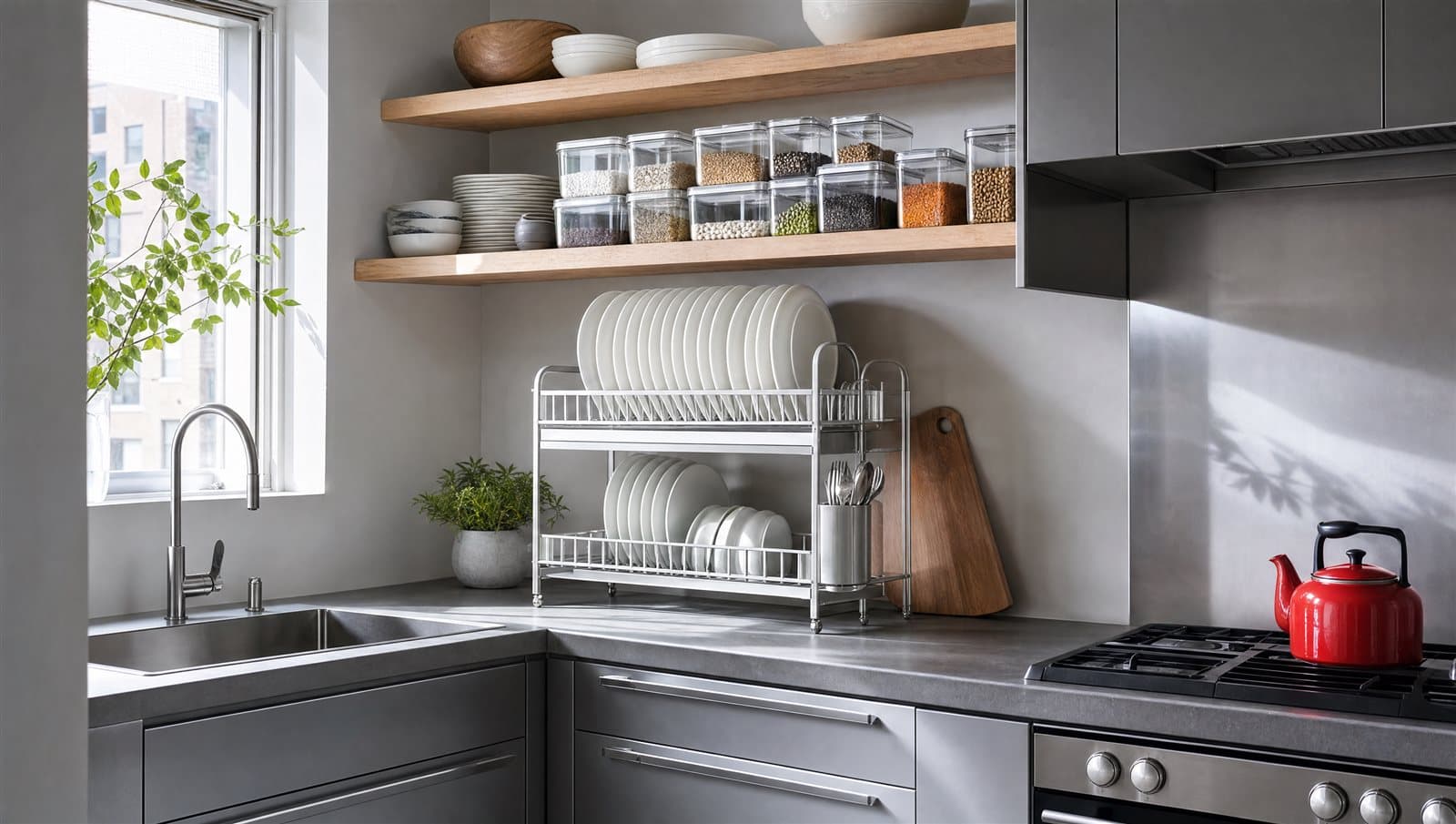
Most kitchen-organization advice is written for houses with walk-in pantries. UAE apartment kitchens are a different sport: two or three metres of counter, a handful of cabinets, and everything from the rice cooker to the karak pot competing for the same space. After helping thousands of customers outfit exactly these kitchens, here are the twelve ideas that actually survive contact with daily life.
Start with the sink (ideas 1–3)
- Get the drying dishes off the towel. A flat towel by the sink holds six plates, breeds damp, and permanently occupies your best counter space. A tiered rack holds a full family wash-up on the footprint of a chopping board — a 2-tier aluminum dish rack stacks plates above bowls instead of beside them.
- Choose a rack that drains itself. The difference between a rack you love and one you resent is the drip tray. Auto-drainage racks angle the tray into the sink, so you never lift a tray of grey water again. On a big wash-up day, a 3-layer rack with auto drainage holds pots, plates, and cups in one vertical column.
- Aluminum over plastic, every time. In a humid kitchen, plastic racks stain and grow film in the joints; rust-proof aluminum wipes clean and stays presentable for years. This matters more in apartments where the rack is permanently visible.
Think in vertical space (ideas 4–6)
- Cabinets are twice as tall as you use them. The 15cm of dead air above every stack of plates is free real estate — shelf risers double a cabinet's usable layers.
- Hang what you reach for daily. A rail or hooks for the three utensils you actually use every day (not all fifteen) keeps the drawer for the rest.
- Top shelves are for "sometimes" things. The dallah for guests, the big biryani pot, the picnic flask — up high, in labelled order. If you use it weekly, it lives at shoulder height; monthly, above your head.
Contain, don't stack (ideas 7–9)
- Decant the staples. Rice, flour, sugar, and spices in square airtight containers stack cleanly and survive humidity; the original bags do neither. Square containers waste no shelf space — round ones lose a fifth of it. Browse our storage & organization range for stackable options.
- One "junk basket", strictly enforced. Every kitchen accumulates cables, warranty cards, and batteries. Give them one basket. When the basket is full, the basket gets sorted — not a second basket.
- Group by task, not by type. Keep the teapot, cups, sugar, and spoons together — a "tea station" — rather than cups with cups and spoons with spoons. Mornings assemble themselves.
Protect your counter space (ideas 10–12)
- The counter is for cooking, not storage. Hard rule: only daily-use items stay out. In most kitchens that is the kettle, the dish rack, and one more thing. Everything else earns its place back each morning or moves to a shelf.
- Give the flask a home. The water bottles and flasks that end up crowding the counter belong in one cabinet spot, lids off, ready to grab — see why in our guide to keeping drinks hot and cold.
- Ten minutes on Friday. Not a deep clean — a reset. Everything back to its assigned spot once a week is what makes the other eleven ideas permanent instead of a one-time cleanup.
A note on humidity
Air-conditioned apartments by the coast live with condensation: cabinets near external walls run damp, and anything that traps water — towel-dried dishes, plastic rack joints, sealed containers put away wet — eventually smells. The pattern behind several ideas above is the same: let air reach everything. Racks that drain, containers stored dry, cabinet doors opened while the dishwasher steams. Dry kitchens stay organized; damp ones fight back.
Frequently asked questions
What is the best dish rack for a small kitchen?
A tiered (2- or 3-layer) aluminum rack with auto-drainage. It dries a full wash-up on a chopping-board footprint, drains into the sink so there is no tray to empty, and aluminum stays rust-free in humid coastal kitchens.
How do I organize a small kitchen without renovating?
Three moves cover most of it: go vertical (tiered rack, shelf risers), decant staples into square airtight containers, and enforce a clear-counter rule where only daily-use items stay out. None of them require a drill.
Are aluminum dish racks better than stainless steel or plastic?
Aluminum hits the practical middle: it is rust-proof like plastic but rigid and presentable like steel, lighter than steel, and comfortably cheaper. Plastic degrades and stains fastest in Gulf humidity.
Where should a dish rack go if my counter is tiny?
Directly beside the sink on the drainage side — an auto-draining rack needs the sink edge. If even that is too tight, a taller multi-tier rack trades width for height on the same footprint.