
How Long Does a Vacuum Flask Keep Drinks Hot (or Ice-Cold)?
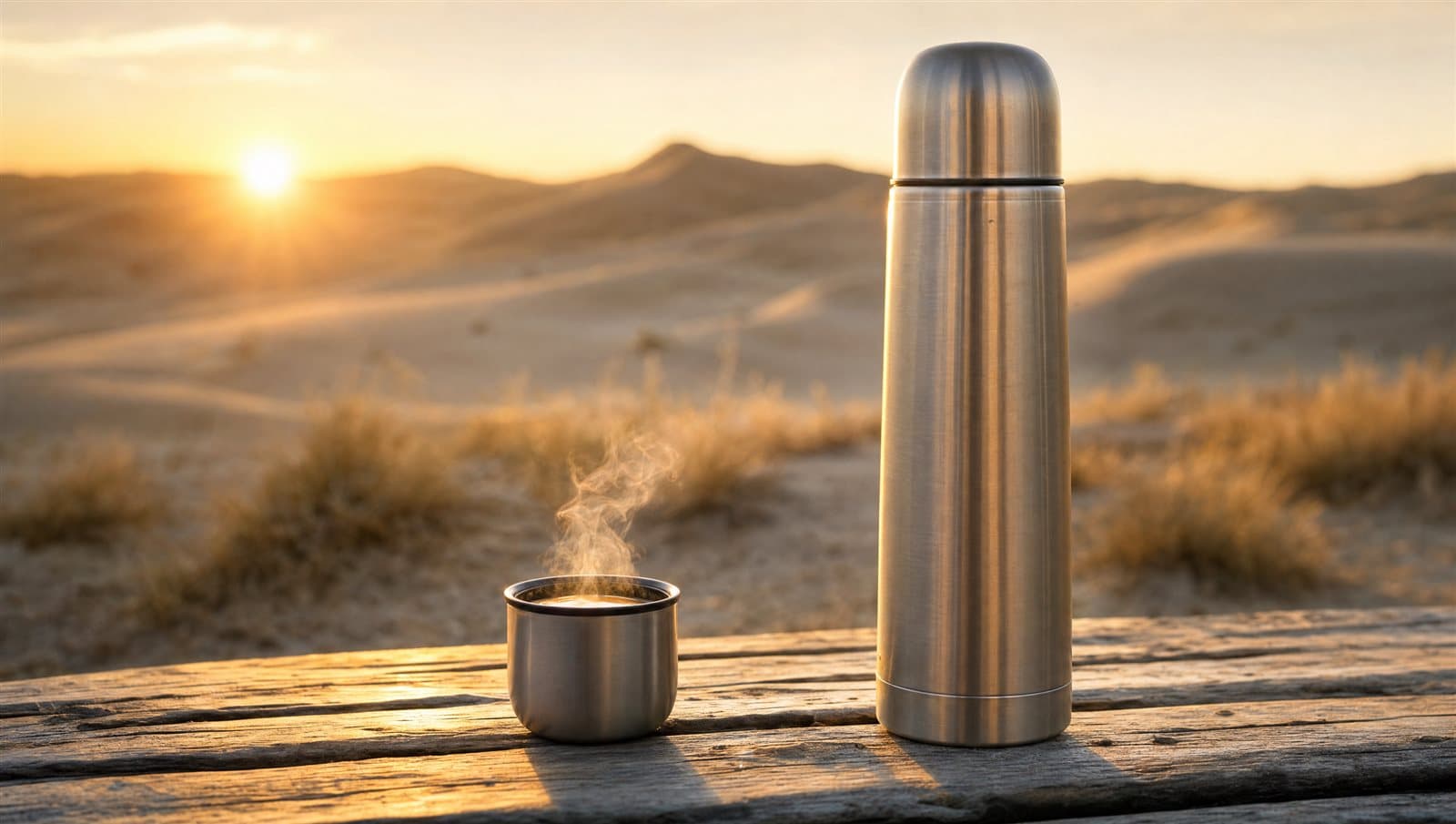
The question we get asked more than any other about flasks is the simplest one: how long will it actually stay hot? The honest answer is "it depends" — but it depends on a short list of things you can control, and once you know them, a good vacuum flask will hold hot karak from the morning school run to the evening, or keep water genuinely cold through a full day on the dunes in August.
The real numbers
A vacuum flask works by putting a near-vacuum between two steel walls — heat cannot cross empty space by conduction, so your drink loses temperature only through the lid and the small contact points. In practice, with a quality double-wall stainless flask:
- Large flasks (1.5–2.0L) — roughly 12 hours hot / 24 hours cold. Our 2.0L flask is rated for exactly that, and the physics is on its side: more liquid holds more heat energy, so bigger flasks always outlast small ones.
- Mid-size flasks (around 1.0L) — expect 8–12 hours hot, comfortably a full workday.
- Personal bottles (0.5–600ml) — like a 600ml vacuum bottle — around 6–8 hours hot, 12+ hours cold. Smaller volume, less stored energy, faster drift. Still easily "coffee is hot at lunch".
Those figures assume a full flask with the lid closed. Which brings us to the part most people skip.
Seven ways to make any flask last hours longer
- Preheat before hot drinks. Fill the flask with boiling water, close it, wait two or three minutes, pour it out, and then add your drink. Otherwise the first thing your tea does is spend its heat warming cold steel. This one habit adds hours.
- Pre-chill before cold drinks. Same trick in reverse — a few ice cubes and cold water for a couple of minutes before you fill it.
- Fill it all the way. Air inside the flask is the enemy; a half-full flask has a large air pocket that keeps stealing heat every time you open the lid. If you only need half the volume, a smaller bottle will genuinely perform better.
- Open it less. Every pour dumps the hot air layer and pulls in room air. A flask opened once at lunch stays hot far longer than one opened every twenty minutes.
- Keep it out of the car cabin. A parked car in a UAE summer reaches 60–70°C inside. Insulation slows heat transfer both ways — but a cold bottle sitting in a 65-degree cabin all afternoon is fighting a war it will eventually lose. Footwell or boot beats the seat in the sun.
- Ice matters more than cold water. For cold drinks, ice cubes are stored cold: the drink stays at 0°C until the last ice melts. A flask filled with iced water in the morning still rattles at iftar.
- Check the seal once in a while. If performance suddenly drops, the culprit is almost always the lid gasket — dried out, cracked, or seated wrong after cleaning — not the vacuum itself.
Keeping a flask clean (and why it smells)
Tea and karak leave tannin films; milk-based drinks leave residue that turns into smell. The fix is cheap and takes five minutes:
- After every use: rinse with warm water and a drop of dish soap, lid disassembled if yours comes apart.
- Weekly, or when it smells: a tablespoon of baking soda in warm water, close, shake, leave for 30 minutes, rinse. For stubborn tea stains, white vinegar works the same way.
- Never the dishwasher. Prolonged hot immersion can compromise the seal between the two walls — the vacuum is the whole product.
- Store it open and dry. A sealed damp flask grows exactly the smell you think it does.
Flask or bottle — which one do you actually need?
The names get used interchangeably, but the use cases split cleanly:
- A vacuum flask (1.0–2.0L, often with a cup lid) is for serving several cups over a day — majlis tea, office karak, camping trips, the school-run thermos that pours six cups.
- A vacuum bottle (0.5–600ml, drink-through lid) is personal: your own water at the gym, in the car, at your desk.
Most households genuinely end up wanting one of each — the big one lives in the kitchen, the small one travels.
Frequently asked questions
How long does a 2L vacuum flask keep water hot?
A quality 2.0L double-wall stainless flask keeps drinks hot for around 12 hours and cold for around 24 — assuming it was preheated, filled fully, and kept closed between pours. Half-filling it or opening it frequently can cut that time roughly in half.
Why is my flask not keeping drinks hot anymore?
Check the lid gasket first — a worn or badly seated seal is the cause in most cases and is easy to fix. If the outer wall of the flask gets noticeably hot or sweats when the contents are hot or cold, the vacuum between the walls has failed and the flask should be replaced.
Can I put lemon water, laban, or fizzy drinks in a stainless flask?
Lemon water and other acidic drinks are fine in food-grade stainless steel for a day. Milk-based drinks are safe for a few hours but clean the flask promptly afterwards. Avoid sealing carbonated drinks — pressure builds and the lid can spray or jam.
Is a vacuum flask worth it in the UAE summer?
It is arguably more useful here than anywhere: the same insulation that holds 12 hours of heat holds a full day of ice in 45°C weather. For beach days, dune trips, and the daily commute, a pre-chilled flask of iced water is the cheapest air conditioning you will ever buy.