
How to Choose Non-Toxic Cookware: A Practical Guide for UAE Kitchens
Walk down any cookware aisle in the UAE and you will see the same promises on every box: "non-stick", "eco", "healthy", "PFOA-free". Some of those claims mean something. Some are just paint. This guide explains, in plain language, what actually makes a pan safe to cook in, what the labels mean, and how to keep a good pan safe for years — because even the best coating becomes a problem if it is abused.
What "non-toxic" actually means
When people worry about cookware, they are usually worried about two things:
- PFOA — a chemical once used to manufacture traditional non-stick coatings. It has been phased out of reputable cookware for years, but "PFOA-free" remains the minimum bar. If a pan does not say it, put it back.
- Coating breakdown — any coating, however safe when new, becomes a problem once it is scratched, chipped, or overheated until it smokes. A large share of "is my pan safe?" questions are really "is my damaged pan safe?" — and the honest answer is no.
So a genuinely non-toxic setup is two things at once: a pan made with a safe, certified coating, and a pan that is still in good condition. You control the second half.
Granite coating, explained without the marketing
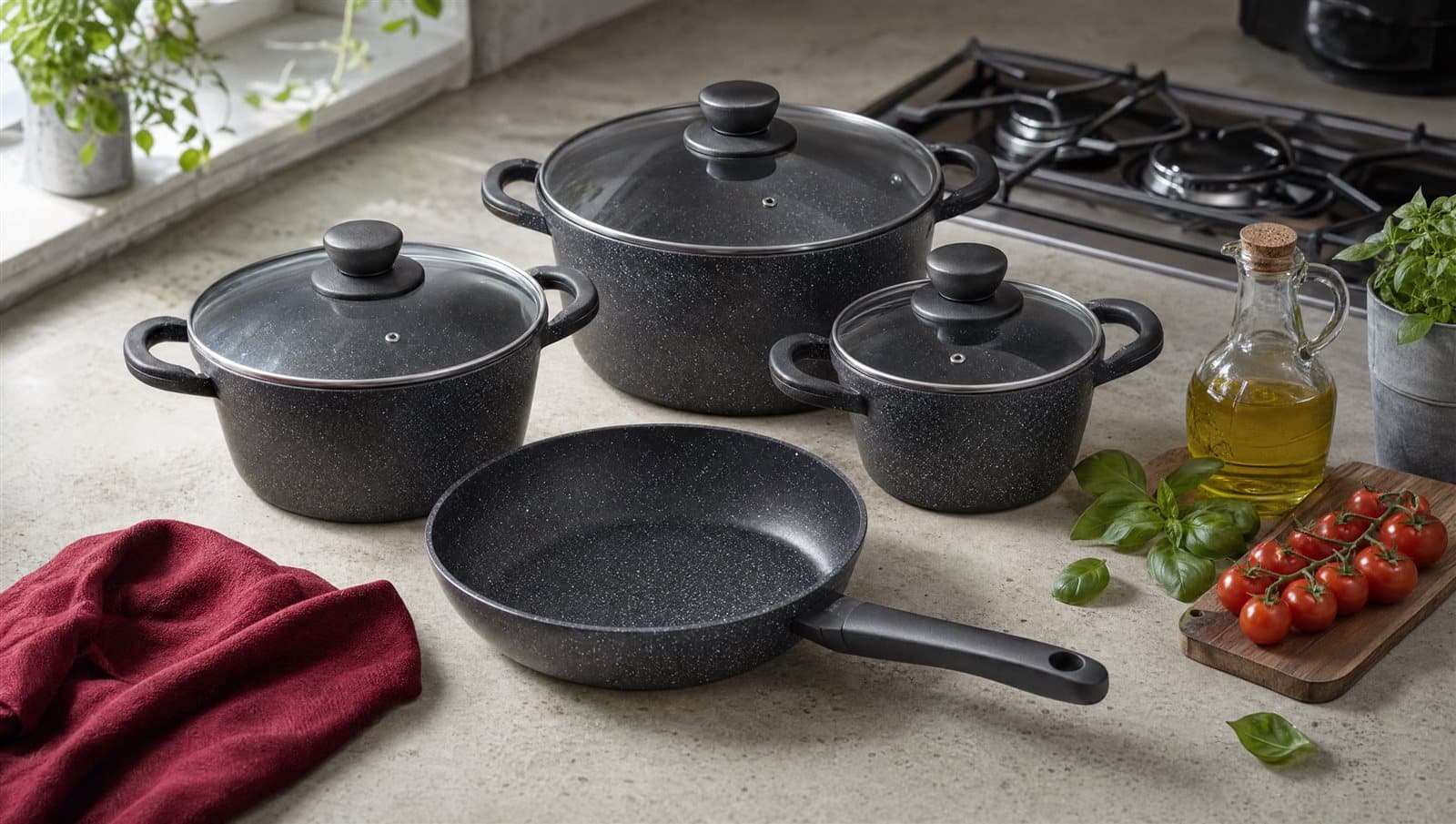
Most of the cookware we sell — like our 10-piece granite cookware set with induction bottom — uses a granite (stone-effect) non-stick coating. Despite the name, there is no actual rock in it: it is a modern non-stick layer reinforced with mineral particles, which does three useful things:
- The mineral texture makes the surface harder and more scratch-resistant than the smooth non-stick pans of a decade ago.
- It releases food with very little oil, which is the everyday health benefit people actually notice.
- It is manufactured without PFOA.
Is granite coating magic? No. It is a better, tougher version of non-stick — and it still deserves the same respect: no metal utensils, no screaming-hot empty preheats.
Six things to check before you buy any cookware set
- The coating claim in writing. "PFOA-free" printed on the product, not just said by the seller.
- The base. A thick, flat induction-compatible base heats evenly on every stove type — gas, ceramic, and induction. Thin bases create hot spots, hot spots burn food, and burnt-on food is what tempts people into steel wool.
- Lids that actually fit. Tempered glass lids let you check rice without releasing the steam that was cooking it.
- Handles that stay cool. Bakelite or silicone-wrapped handles matter more than they seem the first time you grab a pot one-handed while holding a phone.
- The right pieces, not the most pieces. A 10-piece set with two or three pot sizes, a frying pan, and real lids beats a 15-piece set padded with plastic spoons.
- A seller who will answer questions. Cookware is a years-long purchase. Buy it from someone you can actually reach — our contact page lists a phone and WhatsApp number that real people answer.
How to keep a non-stick pan non-toxic
These five habits are the difference between a coating that lasts five years and one that fails in eight months:
- Medium heat is the ceiling. Non-stick coatings do not need high heat — food releases at medium temperatures. Overheating an empty non-stick pan is the single fastest way to damage it.
- Wood or silicone utensils only. Metal spatulas score the surface; every scratch is a place where the coating starts to lift.
- Let it cool before washing. A hot pan hitting cold tap water can warp the base and stress the coating. Two minutes of patience.
- Soft sponge, warm water, normal soap. If something is stuck, soak it. Steel wool is how good pans die.
- Stack with a towel between pans. Most coating scratches happen in the cupboard, not on the stove.
When to replace a pan
Replace a non-stick pan when the coating is visibly scratched through, flaking, or blistered — not on a fixed schedule. A well-treated granite-coated pan looks essentially new for years; an abused one tells you clearly when it is done. If you can see the metal through the coating in the middle of the pan, that is the sign.
What about stainless steel?
For high-heat, long-duration cooking — stocks, pressure cooking, hard searing — uncoated stainless steel is the right tool, and it is effectively immune to the wear concerns above. That is why a stainless steel pressure cooker plus a granite-coated set covers a full kitchen: steel for the violent jobs, coated pans for eggs, fish, and everyday cooking. You can browse the full range on our cookware sets page.
Frequently asked questions
Is granite cookware safe for daily cooking?
Yes — granite-coated cookware made without PFOA is safe for everyday use at normal cooking temperatures, as long as the coating is intact. Treat it with wooden or silicone utensils and medium heat, and replace it if the coating ever flakes.
Does induction-compatible cookware work on gas stoves?
Yes. An induction base is simply a flat magnetic steel layer; it works on gas, electric, ceramic, and induction stoves alike, and its extra thickness gives more even heat on all of them.
Can I put non-stick cookware in the dishwasher?
Most manufacturers technically allow it, but hand-washing is gentler and takes seconds — non-stick surfaces release food with a wipe. Dishwasher detergent is abrasive and shortens coating life.
Why did my old non-stick pan start sticking?
Almost always one of three reasons: cooking on high heat, invisible scratches from metal utensils, or a film of burnt oil residue. The first two are permanent; the third can sometimes be removed with a baking-soda paste and a soft sponge.